
Dedicated to Dr. Jane Goodall and all fellow humans who are manifesting a better tomorrow!
Thank you for caring, sharing and helping carry on Dr. Goodall’s legacy.
OFFICAL TRAILER for
Primates, Privilege & Possibility
“The world is watching. The future is unwritten. And we are the authors of what comes next.” ― Ken Breniman
APE-KIN = ape-reciate kindness
applied primatology · sound healing· evolutionary stewardship
what if our closest relatives could help us remember how to be human?
APE KIN is a living experiment in applied primatology—bringing what we know about apes into how we live, relate, and take responsibility for the world we’re shaping.
this evolutionary work lives at the intersection of
curiosity · care · sound · privilege · possibility
our mission…
to translate what apes teach us about connection, cooperation, and care into practices that support their wellbeing, and transform humanity.
or, more simply:
less dominance. more kinship.
“What you do makes a difference, and you have to decide what kind of difference you want to make.”
— Jane Goodall
what we offer…
-
i’ll say it plainly:
i’m not Jane Goodall.
but i am listening to her final call—to act, not just admire.what this looks like
APE KIN steps into applied primatology—not as armchair theory, but as lived practice.
offerings include:
workshops translating primate behavior into human insight
private coaching around power, privilege, grief, and responsibility
a book club using subversive acts of humanity as our shared compass
this is about asking better questions:
what do apes know about repair after conflict?
why does cooperation outperform domination?
how do social mammals survive complexity without losing compassion?
no pedestal.
no saviors.
just learning and evolving together. -
singing bowls for apes in captivity
this arm of APE KIN raises funds to gift zoos and ape sanctuaries sets of singing bowls for use as auditory enrichment.
not performance.
not therapy.
not forcing engagement.just sound, offered slowly and respectfully.
why sound?
research in animal welfare and enrichment shows that:
novel, non-invasive sensory input can reduce stress behaviors
predictable, gentle auditory stimuli can support regulation
choice-based enrichment (approach / avoid) improves wellbeing
sound bowls provide:
low-frequency vibrations
sustained, non-startling tones
an experience apes can investigate—or ignore
the guiding principle is simple:
choice equals respect.funds support:
singing bowl sets + mallets
delivery to sanctuaries and zoos
documentation and shared learning
any amount is ape-reciated.
-
this short documentary follows my journey to Borneo, where i’ll spend time near orangutan sanctuaries—listening, observing, and asking uncomfortable but necessary questions.
the film explores:
what it means to hold privilege in a fragile world
how proximity to apes changes our sense of responsibility
whether curiosity can replace despair
what stewardship looks like when it’s grounded, not performative
this isn’t a savior story.
it’s not a travel diary.it’s a reflection on choice—and what we do with the power we already have.
-
there is a kind of grief many people are carrying that doesn’t fit neatly into personal loss.
it’s the grief of watching ecosystems collapse.
the grief of knowing too much and feeling powerless.
the grief of loving a planet that is clearly in distress.this is planetary grief—and it lives in the body.
why yoga therapy?
when grief has no clear ending, the nervous system stays activated.
when despair has no container, the body braces.
when loss feels collective and ongoing, the mind loops and the heart numbs.yoga therapy offers a way to stay present without collapsing.
this work draws from:
trauma-informed yoga therapy
polyvagal-informed practices
primate attachment and regulation research
grief theory and thanatology
rather than bypassing grief, these practices:
help regulate overwhelm
restore a sense of agency
reconnect people to their bodies as allies
transform paralysis into grounded care
this is not about fixing the world through yoga.
it’s about becoming capable of staying in relationship with it.
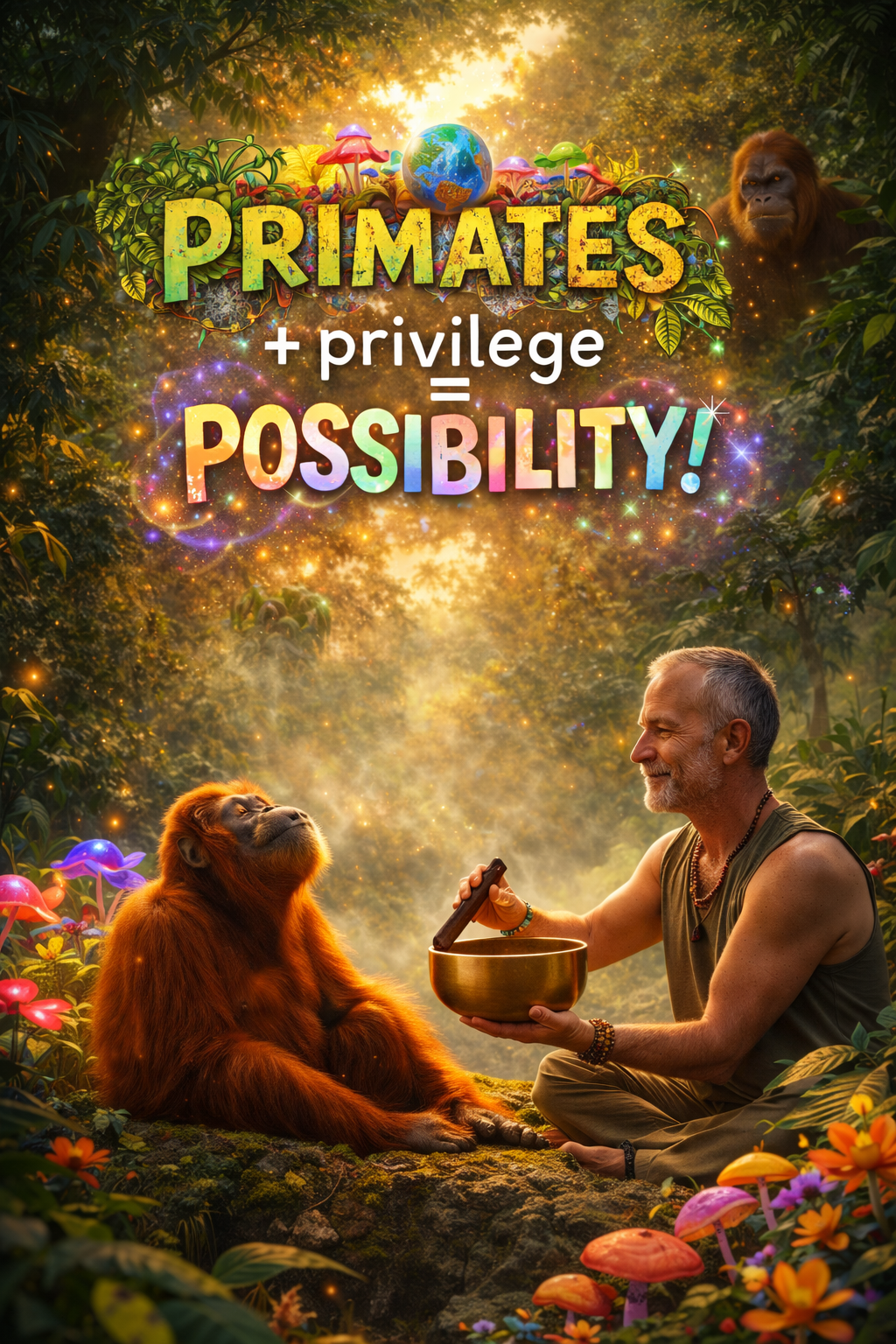
Primates, Privilege, and Possibility is a short documentary following my journey to Borneo, where time spent near orangutans becomes a mirror for examining power, care, and responsibility. Through sanctuary visits, sound offerings, and conversations with everyday people, the film asks how privilege shapes what we protect, ignore, or repair.
Rather than offering solutions, it invites reflection on choice and how small, embodied acts of attention can counter despair. In an era of planetary grief and burnout, this film matters because it reconnects conservation to nervous systems, relationship, and humility.
It reminds us that hope is not naïve optimism, but practiced stewardship, learned from our closest living relatives, and invites viewers into purposeful participation.
Let’s Work Together
If you’ve ever felt overwhelmed by what’s happening to the planet,
or unsure where your care actually belongs,
you’re not alone—and you’re not broken.
APE KIN is an invitation to slow down and reconnect.
With ourselves. With each other. With the animals who remind us how cooperation, repair, and care actually work.
Primates show us that connection eases conflict and that community matters more than control. We humans take those lessons seriously and bothrough sound, movement, conversation, and conservation.
This isn’t about saving the world alone.
It’s about doing something meaningful together.
If you want to collaborate, donate, learn, or simply listen…
there’s a place for you here.
Less dominance. More kinship. Less hubris. More humility. Less ambivalence. More purposeful action.